Публикуется в электронном виде на правах учебного курсового проекта.
The irregular infrared local area networks (IRLAN)
The irregular infrared local area networks (IRLAN) can be used as a segment in a LAN and in a WAN. A transmitter for such system may be designed with the strong power IR-lighter that ordinally provided in the security videocontrol systems. This unit can be work with a semiconductor DC-modulator or with a crystal modulator with a surface acoustic waves (SAW) principle. If an IR-ray power has decrease by a snow or a rain then must increase an output power. For focuse this can use the plastic condensore lenses with big diameter (10...50 cm) that closed with the dark IR-filters. Each principle has a serious problem with the street lighters in the night and with a solar light in the day when the additional light noise sources decrease a sensitivity of the optical IR-recievers. Resolve of this problem is a lenses blending and by two units that must be inverted in a "West-East" direct line placement. One from both will has an effective for half of day. The IR-power is not limited by something.
The distance for a such design can be about 2...3 km in the city. If an IR-lighter will installed on tower with height 20 m and in the natural areas distance will be up to 15 km. This design can be used with an amplitude modulation, a friquency modulation and a phase modulation with the 500 kHz pilot-signal and with a datachannel speed to 56K.
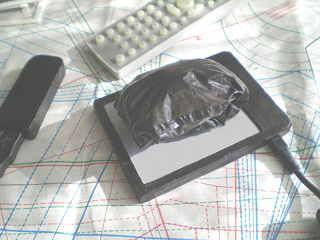
Simple way for listening a signal in an IR-range: the 100...150 IR-photodiods that is likes to the TV- and the DVD-player recievers units and that packed in a small black plastic pocket with hole in a bottom side of this. A pocket lays on an UHF-matrix (an UHF-reciever input unit) window. The data transmission is provides by an IrDA-adapther with an USB-connector. This work by the simple physical priniple that a famous as "a photoeffect" in a hundreds of an IR-PEDs (an infra red sensitive photodiods) in a black pocket. The PEDs has a some electric voltage (about 10 nV and an UHF-signal) with an IR-radiation that can be recieved by an UHF-matrix. Of course, we can made a design in a classic way with a lenses system and an one IR-PED and we have other way.
If you will made a contacts between "+" and "-" for ever an IR-PED then an UHF-signal level will up.
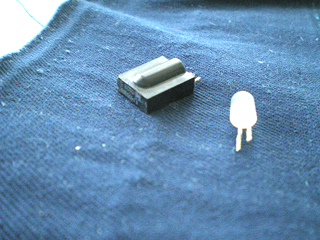
On the photo: an IR-PED (an IR-reciever photodiode) with an intergated black plastic lense (the black plastic is a barrier for a visible light and is not for an infrared light!). A simple LED is placed near.
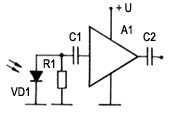
The classical variant of the design for input reciever cascade for an optical modes: a laser connections, an IR-connections.
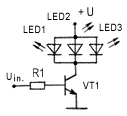
The output cascade for the transmitter: a LED1...LED3 - an IR-diods or "a teacher" lasers.
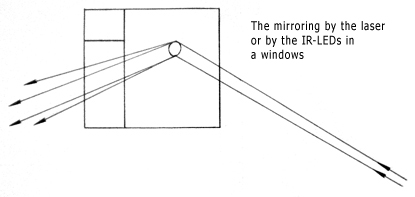
The mirroring from a windows with a laser or an IR-diods provide an irregular local area networks design in the city environment.

The universal optical pelengator for an IRLAN and a LASERLAN searching. The black plastic filter is not presented for a laser light.
[Index]
© 2009 г. Сайт оптимизирован для удобного чтения на мобильных телефонах. Сайт подготовлен при поддержке специалистов компании [Гротек]. Данный сайт не содержит какой-либо (любой) противоправной, а равно - противозаконной информации, либо информации нарушающей чьи-либо гражданские права, а также не сообщает какой-либо (любой) иной (другой) информации могущей привести к противоправным деяниям, если таковые наступают в результате неправильной трактовки этой информации, либо неправомерного ее применения.
